I Built an AI Job Hunter That Works While I Sleep (And You Can Too)
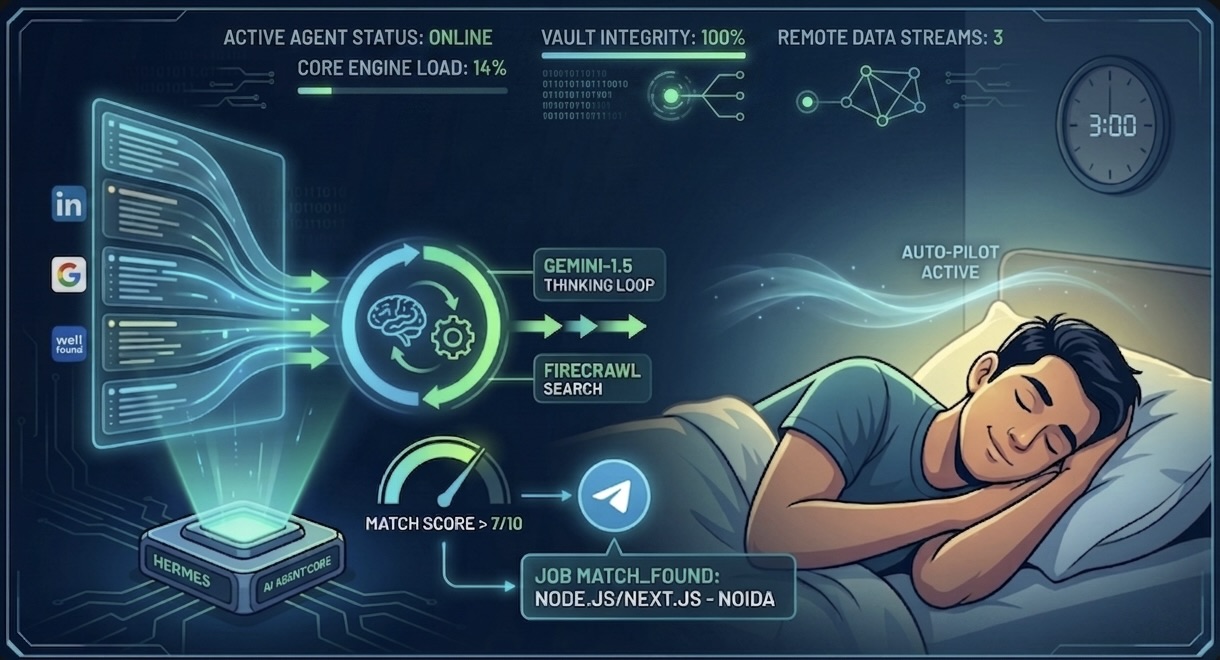
Building an Autonomous AI Job Hunter: A Step-by-Step Technical Guide
In this post, I’ll walk you through how I built an autonomous AI agent that scouts for jobs, analyzes them against my specific tech stack, and notifies me on Telegram when a high-quality match is found.
1. The Architecture
The system is built using the Hermes AI Agent framework. It acts as an orchestrator that connects a Large Language Model (the brain) to local files and external web tools.
Core Components:
- Brain: Google Gemini 1.5 Flash (via API).
- Storage: Local Markdown and LaTeX files for resume and skill definitions.
- Search Engine: Firecrawl / TinyFish API (to bypass bot detection on job boards).
- Communication: Telegram Bot API for real-time alerts.
2. Step-by-Step Implementation
Step 1: Preparing the Source of Truth
Traditional PDFs are hard for AI to parse reliably. I moved my resume from an Overleaf LaTeX project into a plain text/LaTeX file locally. This ensures the AI understands the semantic meaning of my projects, like my AI Book Agent and my experience at Earnest Data Analytics.
Step 2: Configuring the Agent’s "Hands"
To prevent being blocked by LinkedIn or Naukri, I configured a specialized web-scraping provider.
- Tool: Firecrawl API.
- Integration: Configured via
~/.hermes/.envto allow the agent to "see" the live web as structured data rather than a rendered UI.
Step 3: Defining the "JobScout" Skill
I wrote a custom "Skill" in Markdown that defines the agent's behavior. Instead of a simple search, it uses a Reasoning Loop:
- Search: Query for "Node.js" and "Next.js" roles.
- Analysis: Compare the job description against my specific backend experience.
- Scoring: Only proceed if the match score is > 7/10.
Step 4: Automating the Workflow
Using the Hermes internal scheduler, I set the agent to run autonomously every morning. It wakes up, scans the web, performs its analysis, and shuts down, only notifying me if it finds something worth my time.
3. Challenges Overcome
- Bot Detection: Standard headless browsers were blocked instantly. Switching to an API-based search provider (Firecrawl) was the breakthrough.
- Context Management: Ensuring the AI didn't "hallucinate" skills meant providing the raw LaTeX source as context, which contains more technical detail than a standard PDF.
4. The Result
I now have a personal recruiter that works 24/7. It doesn't just find links; it explains why a job is a good fit based on my past work.
Built with: Node.js, Hermes CLI, Gemini 1.5, and Firecrawl.
Keep Reading

Shubham
Full Stack Developer